Bringing the global design community to our doorstep.
The Duda Visiting Designer Program (DVDP) enriches the educational experience at the College of Design by bringing leading design professionals into direct collaboration with students. Through the program, students engage with prominent practitioners to explore pressing contemporary design challenges and develop interdisciplinary solutions.
Established in 2021 by Linda and Turan Duda, FAIA [BEDA ’76], the DVDP creates meaningful opportunities for students to learn from and work alongside the designers shaping their field.
“My goal was to infuse the college and its students with questions that relate to the compelling issues of today and yet have a timeless significance to them”
Turan Duda
Founder, Duda | Paine Architects
2026 | Hasköy in Transition: Resilience, Relocation, and Urban Transformation
What does it mean for a city to become safer and adapt to earthquakes, natural hazards, and changing climatic risks without losing communities, housing, memories, and identities?
This question guides a Fall 2026 interdisciplinary urban design studio bringing together landscape architecture and architecture students at NC State’s College of Design. Co-led by faculty involving Sana Ahrar, Ph.D. (School of Architecture), Celen Pasalar, Ph.D. (Department of Landscape Architecture and Environmental Planning), and Gavin Smith, Ph.D., FAICP (Department of Landscape Architecture and Environmental Planning), the studio explores how cities can become more resilient while maintaining community continuity, cultural identity, housing, and connections to place.
Hasköy, Istanbul Türkiye as a Living Laboratory
Located along Istanbul’s historic Golden Horn, Hasköy brings together cultural diversity, housing, industry, waterfront landscapes, collective memory, and rapid urban transformation, alongside seismic and climate-related risks.
Through the provocative question “How can we relocate without erasing?”students take on both sides of it: what happens to the areas at risk, and what happens to the places that might receive them. This work process involves applied research through the development of urban frameworks and vision plans to detailed designs for housing, mobility, infrastructure, landscape, and public space.
The studio is organized around five interconnected strategies, or 5Rs: Remain, Retrofit, Relocate, Reimagine, and Remember, addressing what should stay, what can be adapted, where relocation is necessary, and how memory and identity endure through change.
International Collaboration
The studio is being offered in collaboration with Istanbul Technical University (ITU), where a parallel studio led by Dr. Dilek Yildiz and Dr. Ozan Ozener is being undertaken. NC State and ITU students and faculty will engage in workshops, discussions, critiques, site visits, and cultural and professional exchanges.
In mid-October, one group of NC State students and faculty will travel to Istanbul to engage with ITU collaborators and further documentation of Hasköy. Another group will lead engagement in North Carolina, connecting with the local Turkish community and NC-based Turkish designers and professionals through conversations and cultural activities. Collectively, students and faculty will create a two-way exchange between North Carolina and Istanbul.
Duda Visiting Designer: Mark Johnson, FASLA, Principal, Civitas
The studio welcomes internationally recognized urban designer and landscape architect Mark Johnson, FASLA, Principal, Civitas as the Fall 2026 Duda Visiting Designer. Johnson will engage with students through lectures, desk critiques, and design reviews, bringing professional and international perspectives to the studio’s exploration of resilience and urban transformation.
His visit will include a public lecture at NC State on October 28th, 2026. This lecture is part of the School of Architecture / AIA Triangle Joint Lecture Series, supported by the Duda Visiting Designer Program, and offered in collaboration with the Department of Landscape Architecture and Environmental Planning.
Through interdisciplinary and international collaboration, Hasköy in Transition challenges students to imagine how cities can become safer and more resilient without erasing the communities, histories, and identities that make them meaningful places.
2025 | Dunne & Raby
Anthony Dunne and Fiona Raby are partners in the design studio Dunne & Raby and Distinguished Visiting Professors at the China Academy of Art.
Through design projects and writing, they explore how speculative thought from science, philosophy, and literature can inform and expand design practice. Their books include Not Here, Not Now (2025), Speculative Everything (2013), Design Noir (2001 / 2021), and Hertzian Tales (1999).
Their projects are in the permanent collections of institutions including the Museum of Modern Art, the Victoria and Albert Museum, and MAK, Vienna, and their research has been supported by organisations including the European Commission, Wellcome Trust, EPSRC, Arts Council England, Mellon Foundation, and industry partners such as Intel and Microsoft.
Through this partnership between Industrial Design and MADTech faculty, we are developing a spring 2025 “research laboratory” course where students will create new knowledge by experimenting with emerging forms of prototyping. Using NC State’s Virtual Production Lab—an immersive modeling and interactive space with leading-edge technology—students will prototype futures for technology and the built environment at human scale.
This course positions speculative design as a methodology for addressing urgent questions of climate adaptation, resource scarcity, and equitable access to technology. Students will translate abstract speculation into design frameworks that prioritize both human flourishing and planetary health. As technology becomes increasingly embedded in our world, the course uses speculative design and future-casting to explore these relationships as both critique and celebration.
Working in the virtual production space, students will design immersive environments at various scales, exploring how environments interact with the human body—from wearable interventions to architectural systems.
2024 | Gabriela Carrillo
Partnering with renowned Mexican architect Gabriela Carrillo, architecture and landscape architecture students explored the urban and environmental complexities of a metropolis rich in Indigenous history and modern challenges as part of this year’s Duda Visiting Designer Program.
“The studio’s focus on the urban scale ignited a passion for urban design, which has already influenced the studios I am choosing to participate in now.”
Andrea Padilla Guerrero
Students examined Mexico City’s historical evolution, land use, density and pressing environmental concerns such as water scarcity and subsidence. They also engaged with cultural and social narratives embedded in the urban fabric, deepening their understanding of how history continues to shape modern infrastructure.
2023 | Not Impossible Labs
This year, students will work alongside Not Impossible Labs, an impact incubator, accelerator, and content studio dedicated to changing the world through innovation and story. Throughout this year’s program, students will develop solution concepts to address issues of food insecurity across North Carolina and beyond.
NIL’s work confronts absurdities in our modern world to bridge the gap between how things are and how they should be with impact-driven solutions.
NIL’s “crowd-solving” projects and innovation programs bring together cross-disciplinary teams from diverse disciplines and backgrounds to a collaborative R&D process dedicated to bold intentions and fueled by commitment, tenacity, and human storytelling.
Program participants will ultimately focus on one or more approaches to tackling the concept of Food Insecurity, using the following tracks as a guide:
Mapping/Breaking Down Food Insecurity
Driving Awareness and/or Aid to Food Insecurity
Designing Solutions for Food Insecurity
2022 | MASS Design Group
The inaugural DVDP session partnered with Boston-based MASS Design Group.
MASS (Model of Architecture Serving Society), is a non-profit organization that focuses on projects involving community histories, narratives and healing from social conflicts. With offices across the globe, they have a team of over 200 architects, landscape architects, engineers, builders, furniture designers, makers, writers, filmmakers and researchers.
Throughout the program, students from the College of Design’s Architecture and Landscape Architecture and Environmental Planning programs were tasked with designing memorials at three specific sites which address North Carolina’s complex history through the lens of racial justice, from the era of slavery to the present day.
Designers from MASS include David Saladik, Jha D Amazi and Sierra Bainbridge, each of whom has an extensive background in working embedded within communities to create public memorials that honor collective identities and recognize the histories of marginalized people around the globe.
Project Highlights
With over 90 students participating in the program, students broke into teams of 5-6 people, evenly split between architecture and landscape architecture students. Throughout the design process, students were able to connect with a pair of alumni mentors for feedback on their projects and receive desk critiques from the participants from MASS.
Below are select works from three of those teams.
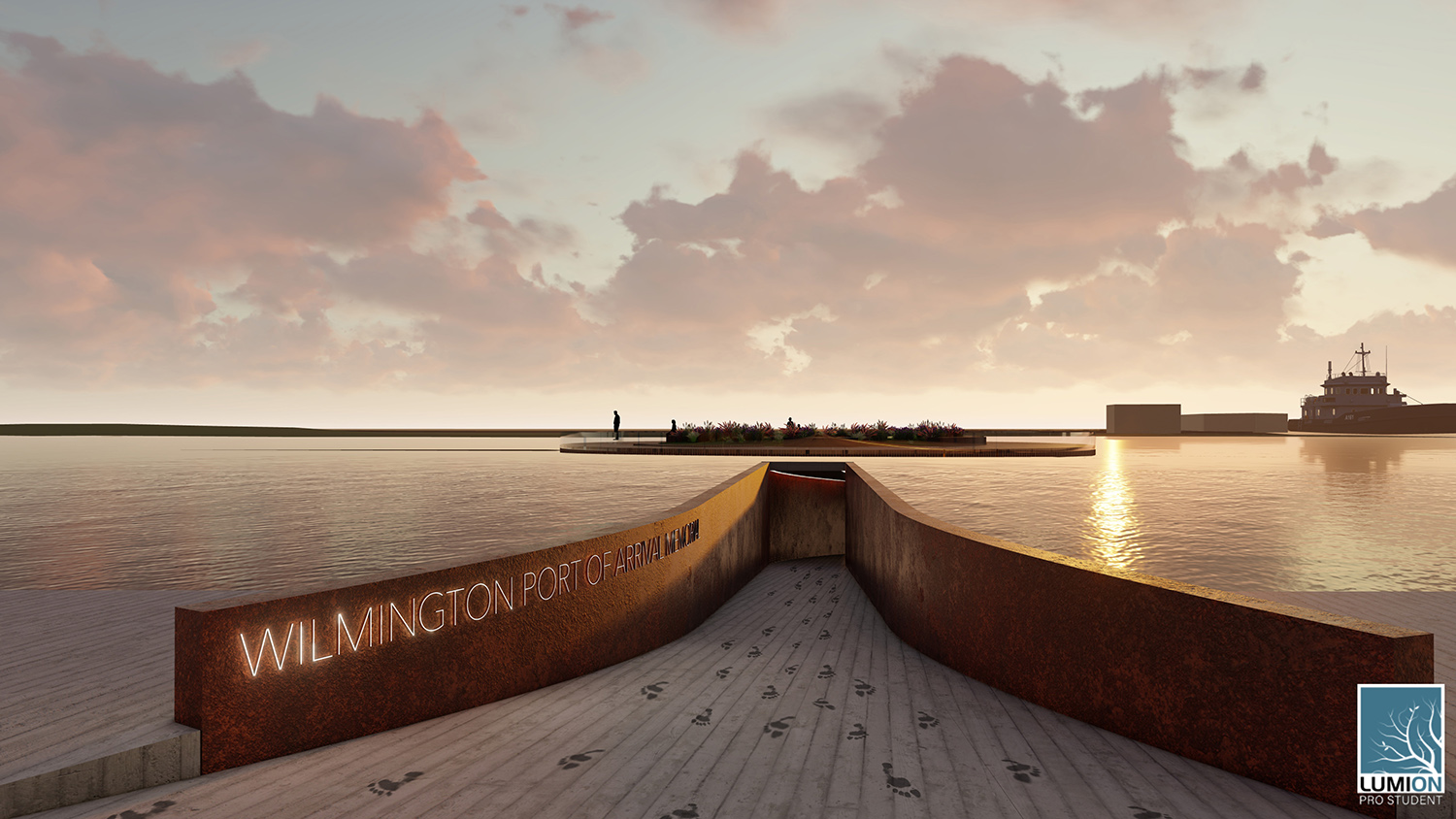
The Wilmington Port of Arrival Memorial
About the Project
Mission Statement: The Wilmington Port of Arrival Memorial honors the enslaved people who passed through this place, inviting reflection on how this history shapes the world we live in today.
Vision Statement: To create a memorial that commemorates the traumatic significance that the port of arrival had in the lives of the enslaved people that passed through it. To provide a space of cathartic healing by enabling visitors to participate in the collective affirmation of the identity and humanity of each of these individuals.
Team Members: Marybeth Campeau, Rebecca Curry, Evan Holliday, Erin Kennedy and Harish Palani
The Crossroads – A Journey of Remembrance + Hope
About the Project
Mission Statement: To bring visitors to an intellectual crossroads by highlighting the African and African American experience of the Middle Passage and slavery, and face these past injustices in order to move toward a future of hope and healing.
Vision Statement: To dedicate space to the experience of those who arrived on slave ships at Port Wilmington, and correct a historical narrative that obscures atrocities suffered and downplays contributions made by this community. This memorial will illuminate history to honor a community integral to our nation.
TeamMembers: Grace Riley, Kyle Wurtz, Lauren Joca, Lauren Waterman and Maya Miller
Chorus
About the Project
Mission Statement: This monument is a reminder that it is through collective action that we may begin to regain the consent of the governed.
Vision Statement: The monument invites visitors to commemorate and celebrate that it is through the participation of the people, the coming together of neighbors, classmates, family, friends, congregations and fellow citizens that we may create change.
Team Members: Carolina Sarmiento, Claire Henkel, Katarina King, Trevor Healy and Mark Storch