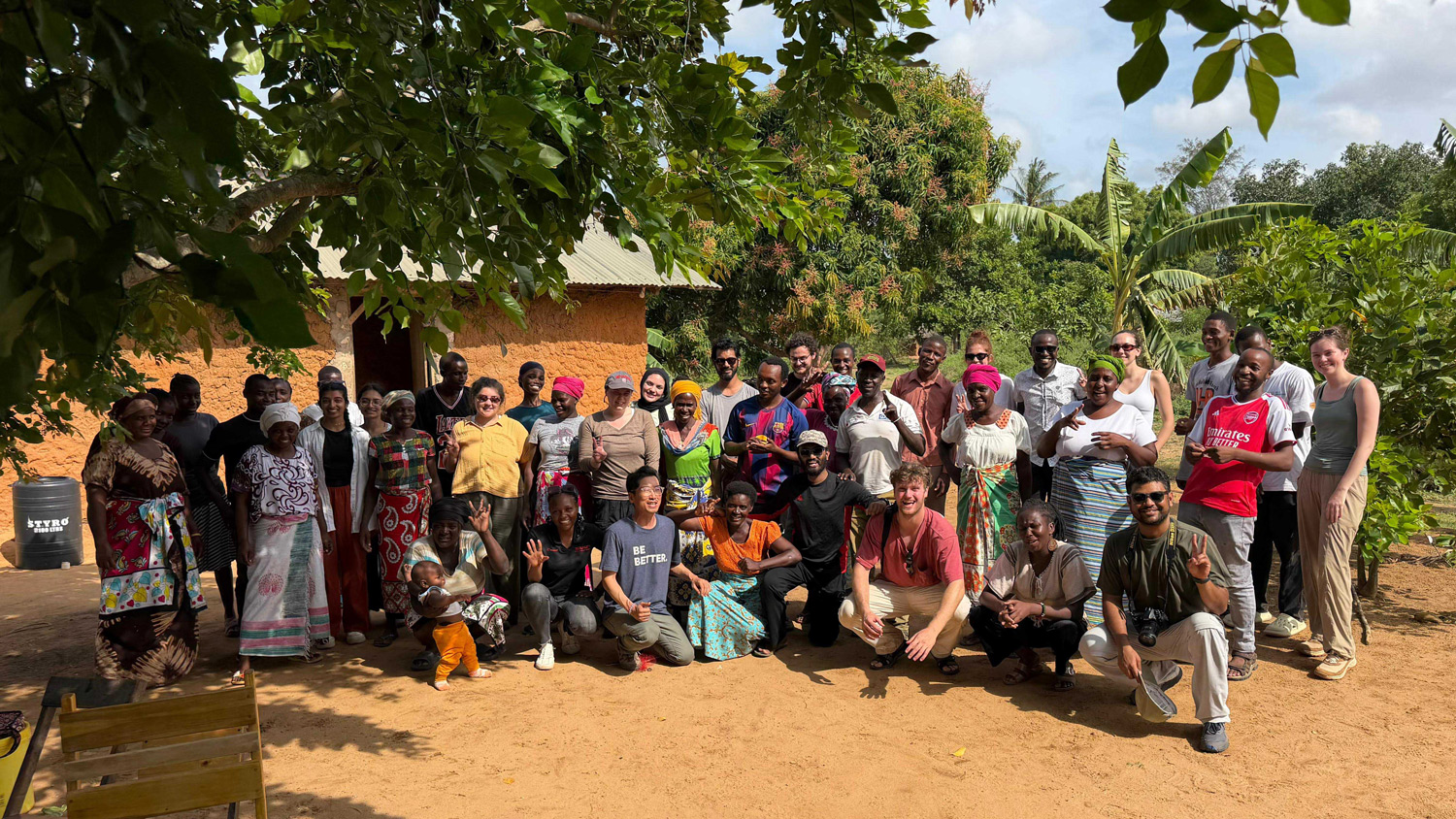
Over Spring Break 2026, a group of NC State University College of Design students traded studio desks for muddy shoes and boat rides, spending March 12–22 immersed in community life on Maya Island in Kilifi County, Kenya. The trip was a part of Studio Kenya: Visioning Spatial Future of Maya Community, a new interdisciplinary Spring 2026 studio in partnership with Pwani University and led by Assistant Professor Donghwan Moon.
The studio was built around a simple but ambitious premise: that design meant to serve vulnerable communities has to be shaped with those communities, not just for them. Open to students in architecture, the course paired academic research with real fieldwork, community workshops, resident interviews and collaboration with Pwani University students and local NGOs. The result was the beginning of a village-scale master plan addressing infrastructure, mobility, resilience and community needs, capped by a final presentation and feedback session with local stakeholders.
A Rhythm Built Around Connection
For Evelyn Lane, a fifth-year Bachelor of Architecture student, the trip had its own daily rhythm. “We began each day with breakfast together, either at our hotel or with our gracious hosts on Maya Island,” she said. “It offered a calm, intentional start and time to talk through the day’s plans.”
Mornings were spent preparing community engagement activities and refining presentations for Pwani University; afternoons brought the full class back together to test engagement strategies or exchange ideas with their Kenyan peers. “Each day concluded with either large or small group dinners, giving us space to unwind and reflect,” Lane said. “While no two days were exactly the same, every experience contributed to our final project, helping ensure our designs responded thoughtfully to the needs of the Maya Island community.”


Confronting the Gap Between Theory and Reality
For Miraz Reza, a final-year Master of Architecture student, the trip reframed how he understood the practice of design itself. “A design proposed without interacting with the users and the community is bound to fail,” he said. Before ever setting foot on the island, his team had drafted a master plan using online data, GIS, and readings. That changed the moment they stepped off the boat into the mud. “It was not a faraway, imaginary community anymore; it was a living, breathing, fresh piece of land with lots of struggles and dreams,” Reza said. “The community’s issues became our challenges, and we became part of the community.” The experience, he added, pushed his team away from chasing “iconic forms” and toward “collaborating, mutual understanding and the triple-bottom line — people, planet and profit.”
Wishing for More Time
Several students said their biggest regret was simply not having more time. Stephen Khamis, a final-year Master of Architecture student, said he wished he could have “walked alongside” residents through an ordinary day — joining children at school, following a father to work in Kilifi, or watching a mother prepare a family’s meals. “The way that they experience and live life is so centered around others, where the bond of community, friendships and family is visibly present,” he said, adding that he wanted to better understand the community’s relationship to tradition, land and the in-between spaces of everyday life.
Sadhana Srinivasan, also a final-year Master of Architecture student, echoed that sentiment. “If I had more time in Kenya, I would’ve loved to spend more time on Maya Island to deeply experience the daily lives of the local community members,” she said. For Srinivasan, more time wouldn’t just mean seeing more — it would mean listening more. “I think that kind of immersion is essential to designing responsibly,” she said.
Leadership Behind the Scenes
As the studio’s teaching assistant, PhD Candidate Raja Bandari experienced the trip from a different vantage point — coordinating workshops, logistics and desk critiques while supporting students, professors and the studio team alike. “The experience strengthened my communication and adaptability skills in a cross-cultural setting,” Bandari said. Coming from a background in spatial analysis and mapping, Bandari said the trip was a reminder that “meaningful design begins with people and relationships,” shaped through “dialogue, trust, observation and shared experiences rather than assumptions made from a distance.”
Carrying Kenya Back to Raleigh
Back in Raleigh, students have translated those weeks of fieldwork, conversation and shared meals into a working master plan for the Maya Island community grounded in the relationships they built along the way. The lessons carried home from the studio extend well beyond architecture: humility, patience and the understanding that good design starts with listening.
For more information about the program, please contact Assistant Professor of Architecture Donghwan Moon at [email protected].
- Categories: