Playing is Learning: Making the Case for Going Outside
The Natural Learning Initiative celebrated its 25th anniversary last year. See how it uses landscape architecture to promote child development and health outcomes.
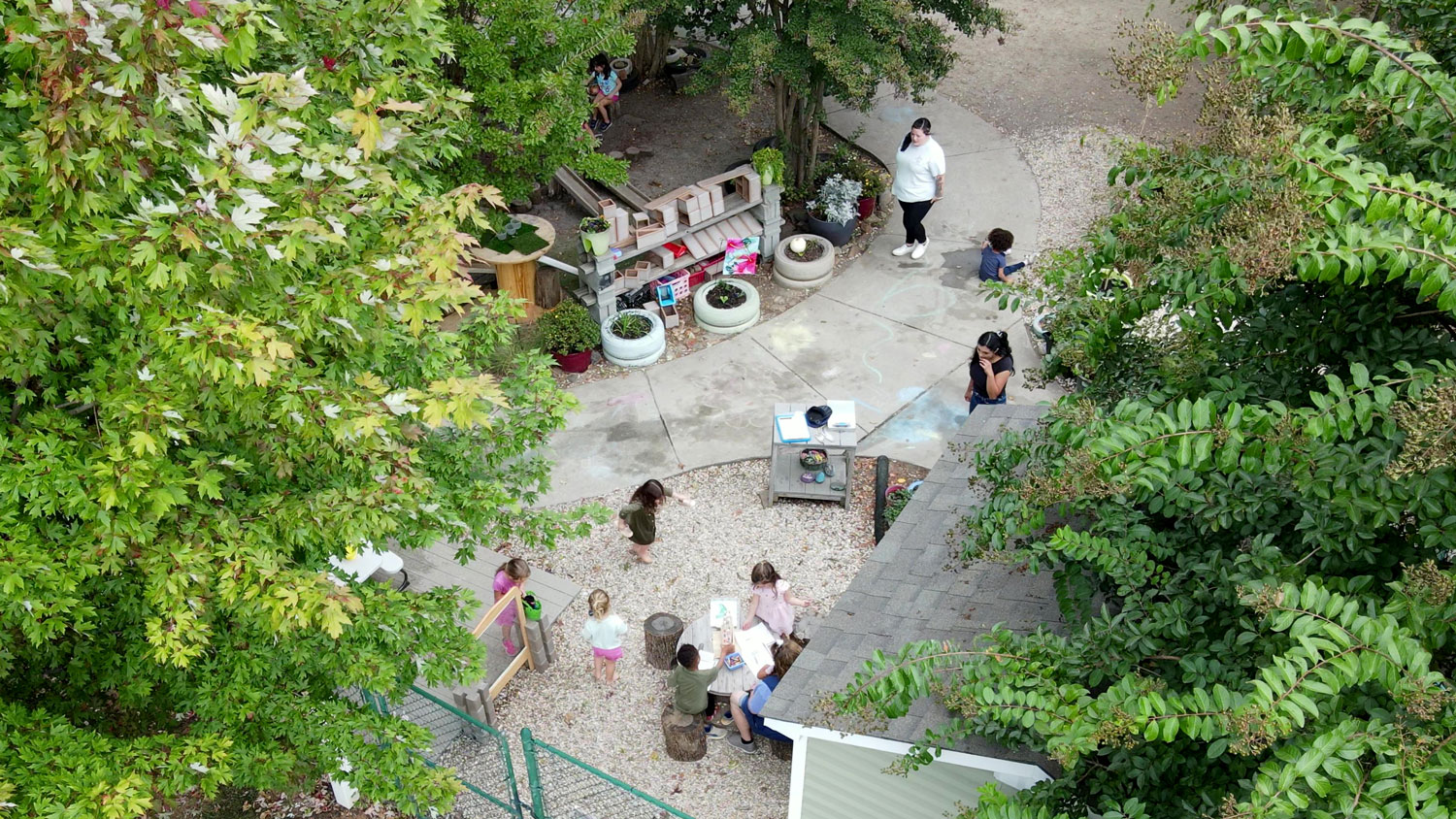
The Natural Learning Initiative (NLI) got its start after two global children’s rights activists each found their way to NC State. For 25 years, co-founders Robin Moore and Nilda Cosco have been using their combined expertise in landscape architecture, urban planning and the psychology of learning to bring back outdoor environments that support child development.
The two met as members of the International Association for the Child’s Right to Play, years before their paths led them to NC State.
“We both come from the field of play,” said Moore. “I was president of that organization for almost 10 years. I’m passionate about children’s play as a way of learning about the environment. That goes back to my own childhood as a kid in the woods in the south of England, doing my own thing.” Cosco, similarly, spent her childhood freely roaming her hometown in the grasslands of Argentina.
Being a kid in the woods or the grasslands, it turns out, has a lot of benefits: self-confidence, cognitive development and a stronger immune system, to name a few. But when Moore was pursuing his master’s degree in city planning from the Massachusetts Institute of Technology in the 1960s, there was no research literature available about child development and the outdoors. That has changed significantly in the last 25 years. This growing body of research, including work by members of the NLI team, has provided Moore and Cosco with a foundation to grow NLI.
“We look upon play as learning; in fact, we call it ‘playful learning,’ especially with young children,” said Moore. “It’s not a separate entity — it’s part of the learning process. It’s very much tied to the natural world, which is the big motivator of play, because nature is constantly changing. It’s not a fixed entity that looks the same day after day. It’s always got something new to offer.”
What sets a natural learning environment apart from a traditional playground is that it’s less structured, less predictable and more like, say, playing in the woods. But it isn’t just about introducing children to nature in a vacuum. NLI takes a holistic, community-based approach to developing play spaces and, ultimately, influencing policy to support healthy child development.
From NLI’s very first project in the late 1990s — the Southern Pines Discovery Park primary school — involving the community has been integral to their process. The group employs co-design processes to engage stakeholders and train them to creatively use and manage the finished playscapes.


In 2007, in collaboration with the N.C. Division of Child Development, NLI launched a signature program, Preventing Obesity by Design (POD), that combines the naturalization of outdoor playful learning spaces with opportunities to conduct research that can inform future work. Ultimately, POD’s goal is to reduce childhood obesity by introducing children to environments that support physical activity, healthy eating and outdoor learning early in life.
“When we started, there was not much research on children’s environments that was high-quality and based on evidence,” said Cosco. “We did a lot of design assistance work to create demonstration sites that we could use for teaching and for showing how these environments grow, how people manage them.”
The demonstration sites allow researchers to observe how children interact with the play environment, creating a feedback loop between design and research. That work informs their professional development program and feeds new projects, becoming one of the secrets to NLI’s success over the years.
NLI’s professional development program, which includes the annual NLI Design Institute, has now served more than 2,300 participants, including public health professionals, nutritionists, teachers, child care center owners and others. NLI also offers a popular course on teaching children to garden — an easy, cost-effective program that can improve children’s physical activity levels and their interest in eating fruits and vegetables.
“The idea is to reach out, to disseminate these ideas, to show how they can be done,” said Cosco. “We have passion for that and a very, very strong commitment.”
NLI collaborates with the International Union for the Conservation of Nature (IUCN) Education Commission to improve spaces where children spend time — such as parks, greenways, residential areas, streets, childcare facilities, schools, botanical gardens, museums and zoos — reminding all involved that children have a right to play, learn and access nature.
Today, NLI is an award-winning national leader in the development of healthy outdoor play environments. The Centers for Disease Control (CDC) appointed NLI as a national provider of technical assistance to serve CDC state funding recipients, expanding NLI’s impact nationally.
True to Moore and Cosco’s roots, the organization remains a dedicated advocate for policies that support nature-connected childhoods. This is an area where Moore hopes NLI continues to have a meaningful impact.
“Most groups write their scientific papers and get them published and they’re happy,” said Moore. “But we’re not. We want to change things out there in the world in a more direct way. For example, our communications team does an excellent job of translating research into easily digestible print and media resources for practitioners.”

Over the years, NLI has been able to work with more than 60 graduate students on design and research projects. “Our work spans many disciplines, both within and beyond design,” said Soolyeon Cho, associate dean of research, doctoral programs and global engagement, and NLI’s interim director. “We hope to see NLI become a hub where students from our college — but also from social science, psychology, implementation science, communication science — can come together to shape the future of this field.”
Moore and Cosco both agree that rooting childhood in nature is the essential heart of the NLI mission — healthy human development and a healthy biosphere for generations to come. Ultimately, they see their work as defining a subfield of landscape architecture that supports healthy children who become stewards and protectors of our planet.
- Categories:


