Made to be Seen: MADTech Students Take Their Stories to ICON13

Sophia Vaughn never submitted her film. Professor Marc Russo did it for her, and she wasn’t sure anyone would care. “I didn’t know that anyone would be interested in watching it!” she said.
Then she traveled to Baltimore with a friend and walked into a screening where, she says, they were both surprised by how many people showed up.
Vaughn’s To Do was one of three MADTech senior animation capstones selected for Motion Commotion, a curated screening at ICON13, the Illustration Conference held in July of this year. Alongside it were Sophie Gabriel’s Snap and Lily Barber’s Feels Like Home.
The films could hardly be more different, but their creators arrived at the same realization: finishing the work was only part of the process. Showing it to strangers was another kind of risk.
Snap by Sophie Gabriel
To Do by Sophia Vaughn
Feels Like Home by Lily Barber
“The heart of the story came through”
Gabriel calls the selection an honor, and admits to feeling “a little embarrassed” too. It’s not stage fright. Every time she watches Snap, she notices something she’d do better now. “I still feel deeply honored though,” she said, “because it means that even with all the flaws and beginner mistakes, the heart of the story came through.”
She’s also clear-eyed about what a screening is. To her it feels “more like a show and tell rather than a rite of passage into the art world.” What mattered most was finishing the film and seeing her professors, friends and family proud of it. But she did learn something new: how closely her instincts line up with those of some audiences.
From a private place to a shared one
For Barber, the stakes of sharing were personal. Feels Like Home grew out of years of housing instability and her changing sense of what home means. Because each painted frame was wiped away to make room for the next, the finished film is the only place those frames still exist.
“I make a lot of art only for myself, most of my work isn’t seen by anyone,” she said. “It’s a really vulnerable experience to have something so personal on such a big screen but at the same time it’s exhilarating.”
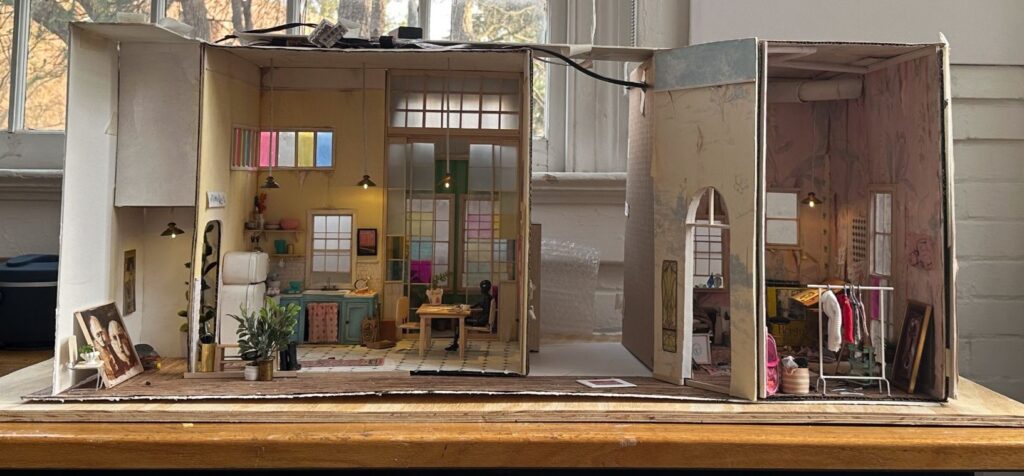
Her own view of the film has shifted since she finished it. She created the piece as a safe place, and at the time that place didn’t include other people. Now she sees the loneliness in it, and her miniature rooms have become something else. “I want to open the proverbial door and let people in,” she said.
The recognition also arrived at a useful time. Life after college has brought competition and rejection, and job postings can make her second-guess her ability. “Being selected for something like this has reminded me that I make art because I love to do it,” she said. “It’s an outlet for expression.”
Another stage of the creative process
Russo has spent years encouraging students to send their work out. MADTech has a long history at film festivals, he said, and ICON is one that knows the program through the work it has submitted over time. He points to jobs and networking opportunities that have come from past screenings.
“ICON13 adds to the completed project,” he said. “The students get to see how their project is received by an audience, they get to watch their film next to other students and professional work, and they get to understand their work in a different context outside the classroom and the college.”
He is just as candid that not every submission is accepted. When a film isn’t selected, he hopes students come away with resilience and tenacity, and with a reminder that “not every film is for every audience.” A film passed over by one festival can still be great for another.
What he most wants them to take away is simple. “My hope is that they learn that they are GREAT,” he said. “They do not see how good they are.”
For Vaughn, the screening did just that. Seeing her work next to other animators’ films left her wanting more. “I wanted to create more because of it,” she said.
Advice for the hesitant
Asked what they’d tell a student who’s proud of their work but nervous to share it, the three offered their own versions of the same nudge.
“There’s an audience out there for you, it’s just a matter of finding those people.”
Gabriel suggests holding onto your pride while keeping feedback at arm’s length, since not all of it will be informed. “Always believe you can do better, but that your best is still worthy of your respect and recognition,” she said. And if you’re scared, do it scared: “There’s an audience out there for you, it’s just a matter of finding those people.”
Vaughn, who describes herself as hesitant to share, urges others to try anyway. They might be surprised.
Barber’s advice is the most direct: “If you’re proud of it, it speaks to who you are, and you think the world would benefit from seeing it, then be brave and put it out there.”
Russo sees that willingness as part of what MADTech students carry with them. “They are hard working creative problem solvers,” he said. “They know how to get an ambitious project done regardless of the medium.”
Three films that began as capstone projects now have audiences far beyond the classroom. As Barber put it, “there are people out there who want to listen.”
This post was originally published in College of Design Blog.


